
Aisha Mahmood
· · 9 min readWhy Mandalas Anchor Every Bridal Hand
Discover why the mandala motif dominates every bridal mehndi design across Indian, Pakistani, and Arabic traditions. We break down the geometric logic, cultural weight, and functional role that makes this radial pattern the non negotiable anchor for full hand compositions.
The Observation That Started This Analysis
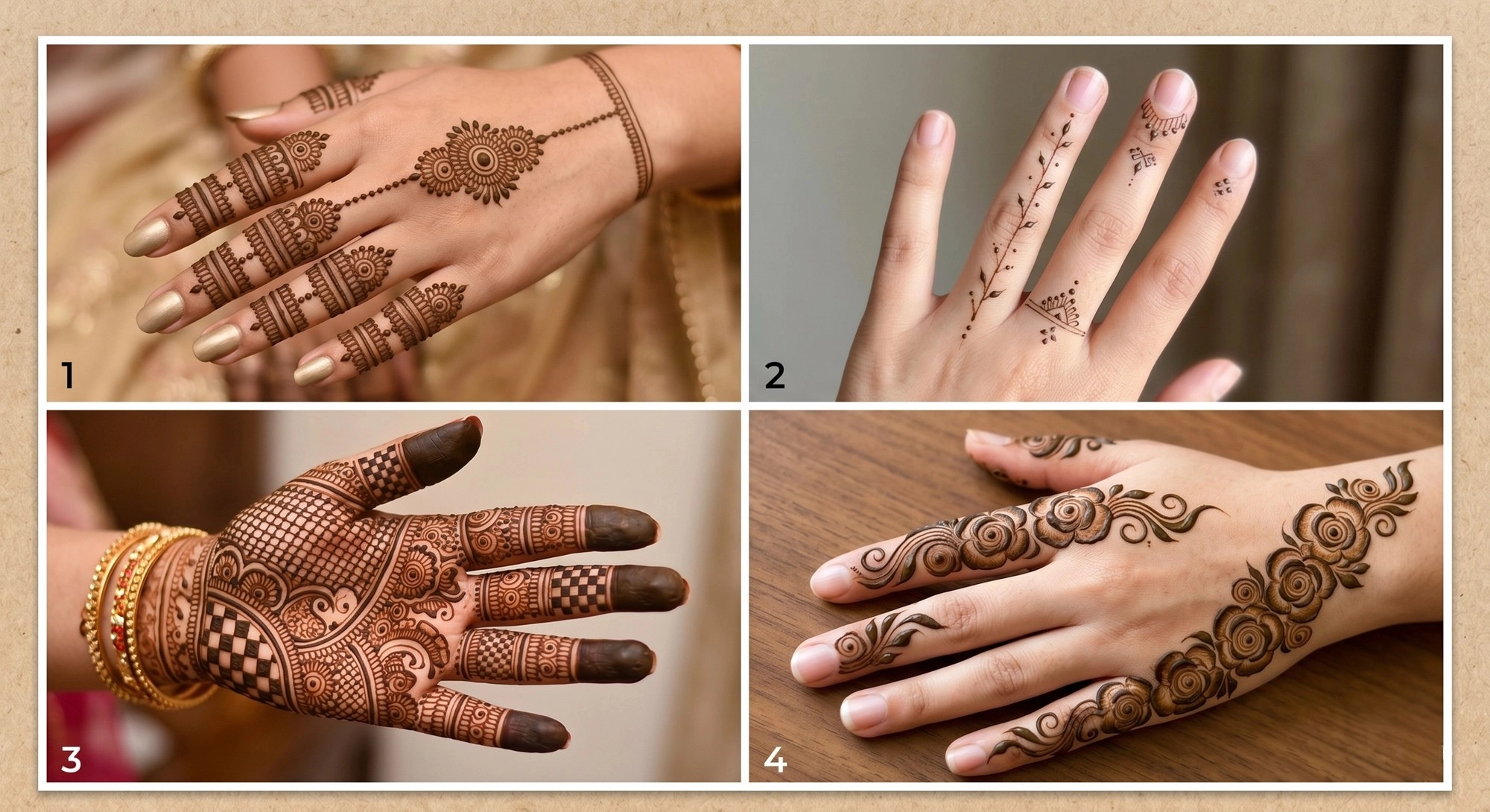
Open any bridal gallery from Karachi to Dubai to Mumbai. Scroll through the first fifty images with fresh eyes. You will notice something that seems obvious once you see it, but most people miss it entirely. The same radial pattern repeats across traditions that should be visually distinct. It appears on palms in Indian bridal mehndi design collections. It anchors back hands in Pakistani portfolios. It even shows up in arabic mehndi design galleries where you would expect bold florals to dominate completely.
The mandala is not just a popular motif that trends in and out of fashion. It is the structural backbone of almost every full hand bridal mehndi design we have catalogued across six years of archive building. Artists return to it for reasons that have nothing to do with client requests or Instagram algorithms. The choice is driven by geometry, cultural weight, and pure functional necessity when working on a three dimensional, moving surface like the human hand.
Here is why the radial circle keeps winning the center spot, and why it will probably remain non negotiable for another generation of brides.
The Geometric Logic That Makes Mandalas Forgiving
Let us talk about what actually happens when you put cone to skin.
Why Straight Lines Fail And Circles Succeed
- A straight line shows every tremor in your hand
- A single wobble becomes visible as a permanent mistake once the stain develops
- A rose petal demands exact curvature and consistent thickness from start to finish
- Get the taper wrong and the whole flower looks amateur
The mandala forgives what other motifs simply cannot. This is not opinion. It is mathematical reality. When you arrange elements around a central point using radial symmetry, the eye reads the overall pattern before it registers individual strokes. A slightly uneven stroke becomes organic movement rather than a technical error. The concentric rings create their own internal rhythm that disguises minor imperfections in line weight or spacing.
Skill Level Adaptability
This is exactly why beginners gravitate toward circle mehndi design for their first serious attempts. You can find hundreds of tutorials teaching easy simple circle mehndi design because the structure stabilizes shaky hands. Master artists still use it as the centerpiece of complex royal front hand mehndi design compositions for the same reason. The motif works at every skill level because it provides a fixed anchor point.
- Quick application: Draw a mandala with a thick cone tip in ten minutes for a simple mehndi design
- Detailed work: Spend an hour layering fine khafif texture inside each ring for a dulhan mehndi design that needs to photograph beautifully
- Consistent results: The silhouette holds its visual weight either way
- Scalable complexity: The internal complexity can scale up or down without breaking the overall composition
The Cultural Weight That Predates Modern Henna
The second reason mandalas dominate is heritage, and this matters more than most people realize. The radial circle predates modern henna trends by centuries, possibly by millennia. It appears across Hindu, Islamic, and Sikh iconography as a symbol of cosmic order and spiritual center. This is not decorative coincidence. It is shared visual language.
Cross Cultural Symbolism
Hindu Tradition
- The mandala represents the seat of Lakshmi and the unfolding of creation from a single point outward
- The concentric rings mirror the chakra system and the layers of consciousness
- Used in wedding ceremonies to invoke divine blessings
Islamic Geometric Art
- Heavily influences pakistani mehndi design and mughlai court aesthetics
- The repeating radial pattern reflects infinity and divine balance
- There is no beginning and no end when you follow the circular path
Sikh Iconography
- Represents spiritual center and cosmic order
- Appears in ceremonial art and decoration
- Connects to broader South Asian visual traditions
When a bride wears a mandala mehndi design at her wedding, she is not just choosing a decorative shape because it looks pretty in photographs. She is carrying a motif that reads simultaneously as ornament and tradition across multiple cultures. The wearer decides how much spiritual meaning to attach to it, but the visual language remains intact regardless. A karwa chauth mehndi design featuring a central mandala connects the woman observing the fast to centuries of married women who drew the same radial patterns for the same reasons.
This cultural breadth is something purely decorative florals cannot match. A rose is just a rose. A lotus carries meaning but is limited to specific regional traditions. The mandala travels across borders without losing its core identity. This is why you see it in indian mehndi design, pakistani mehndi design, and even arabic mehndi design collections where floral clusters usually dominate. The technique changes, the density changes, but the structural role remains identical.
The Functional Role On A Living Canvas
Beyond symbolism and geometry, the mandala solves a practical problem that artists face when working on living, moving surfaces. The human hand is not a flat canvas like paper or fabric. It curves, bends, stretches, and shifts constantly during application. You cannot tape it down or stretch it tight like a tattoo artist can.
How Mandalas Organize Complex Compositions
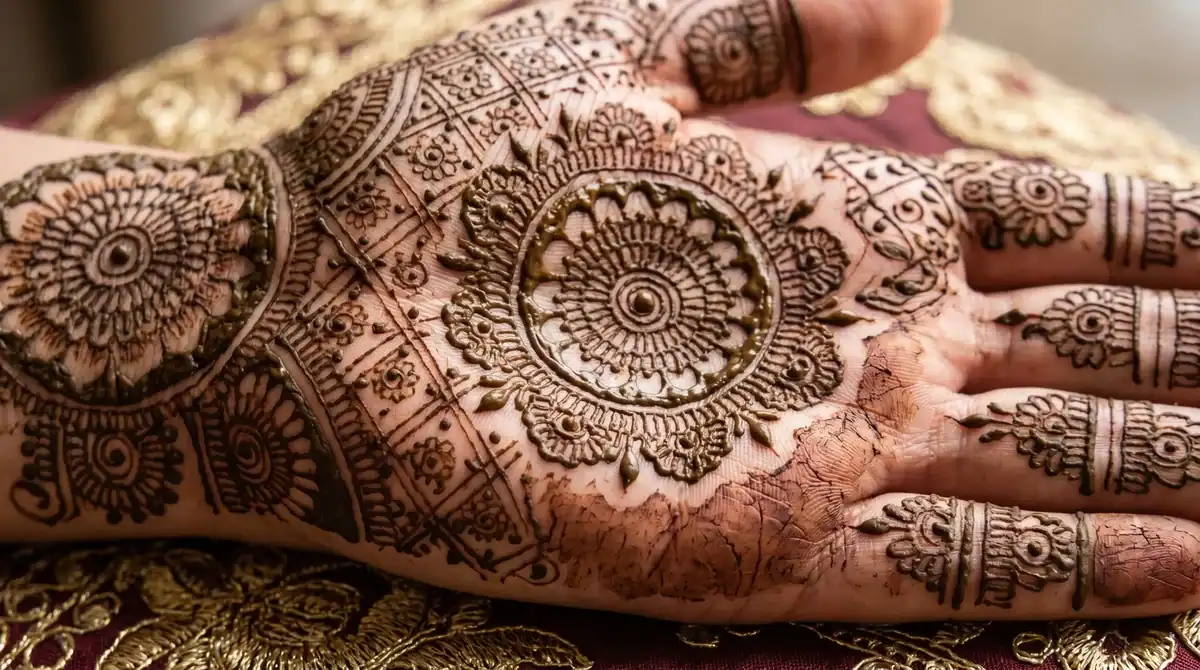
The mandala provides a fixed anchor point that organizes everything else around it. Once the central circle is placed and the concentric rings are established, the rest of the composition falls into place almost automatically.
Structural Benefits:
- Outer rings dictate exactly where the jaal lattice should begin
- Spacing between rings determines how far the bel vines can travel toward the fingers before the design feels unbalanced
- Central focal point keeps the design balanced even when the hand shifts during photography or application
- Visual weight distribution prevents the composition from feeling scattered or lopsided
This anchoring function becomes critical when you are working on a full hand bridal mehndi design that needs to maintain visual coherence across multiple planes. The palm curves differently than the back of the hand. The fingers taper and bend at joints. Without a central focal point to ground the composition, the design can drift and feel scattered once the hand moves.
This is why you will see it consistently across indian mehndi design, pakistani mehndi design, and arabic mehndi design collections. The cultural technique changes. The density of fill changes. The linework weight changes. But the structural role of the central radial motif remains identical because the physics of working on a hand do not change.
Why Mandalas Beat Roses And Paisleys For Palm Dominance
You might wonder why artists choose the circle over other heavy hitters like the rose or the paisley. Both are iconic motifs with deep cultural roots. Both appear constantly in bridal work. But neither dominates the palm center the way the mandala does, and there are specific technical reasons for this.
The Rose Problem
- Small roses lose their petal definition once the stain develops
- What looks like crisp, distinct petals in paste form turns into a dark smudge after the paste flakes off and the oxidation process completes
- Large roses are beautiful, but they lack the internal symmetry needed to anchor a full palm composition
- A rose sits in one spot and does not naturally organize the space around it the way concentric rings do
The Paisley Problem
- Paisleys are asymmetrical by nature
- The teardrop mango shape has a clear direction and flow
- This makes them perfect for filling the sides of the hand or creating trailing vines
- Terrible as a central anchor because a paisley in the palm center creates visual tension that pulls the eye in one direction
- Leaves the rest of the hand feeling unbalanced
The Mandala Advantage
The mandala scales cleanly from a coin sized palm center to a massive forearm statement without losing structural integrity.
Scalability Features:
- Pack dense geometric fill inside it for a full hand bridal mehndi design that needs to photograph with impact
- Leave it open with just three bold rings for a simple mehndi design meant for everyday wear
- Adapt for a kids mehndi design where time is limited
- The structure adapts without breaking
The Cross Tradition Analysis
Looking at how different traditions deploy the mandala reveals interesting variations that tell you a lot about each style’s priorities.
Indian Mehndi Design Approach
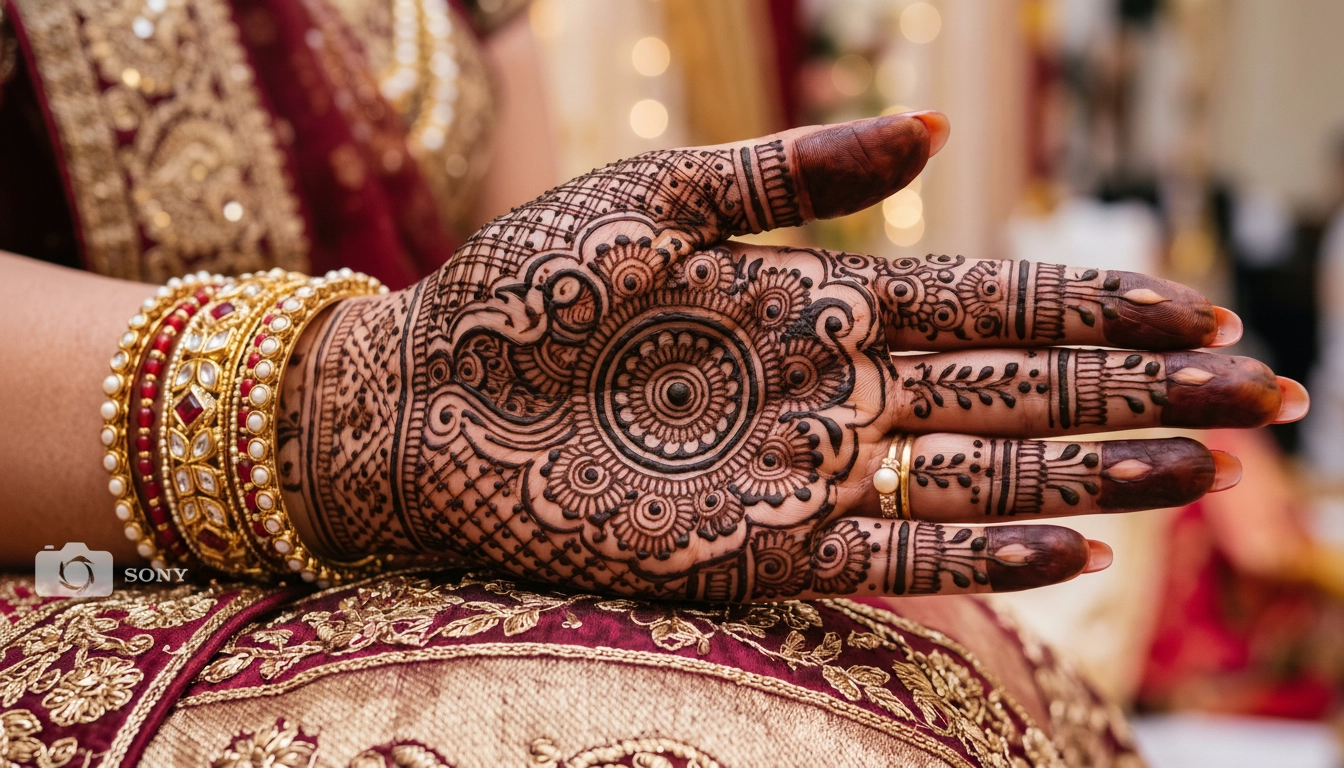
In indian mehndi design, the mandala is typically dense with fine detail work.
Characteristics:
- Multiple concentric rings, each filled with different textures
- Innermost ring might have tiny dots
- Next ring out could have micro petals
- Outer rings often feature fine hatching or crosshatching that creates tonal variation
- The whole composition is meant to stain as dark as possible, so density is the priority
Pakistani Mehndi Design Approach
In pakistani mehndi design, the mandala often features that signature two weight linework.
Characteristics:
- Outer rings are drawn with bold, confident strokes
- Inner details use fine khafif stippling to create texture without overwhelming the bold structure
- The rose knot often sits at the center of the mandala rather than pure geometric rings
- Blends the radial structure with the Pakistani signature motif
Arabic Mehndi Design Approach
In arabic mehndi design, when mandalas appear, they are typically more open and bold.
Characteristics:
- Just three or four thick rings with minimal internal fill
- The negative space between rings is treated as part of the design rather than something that needs to be filled
- Creates a lighter, more breathable composition
- Aligns with Arabic aesthetic priorities
The mandala adapts to each tradition’s core values while maintaining its structural role. This flexibility is why it survives across styles that otherwise have very different visual languages.
The Verdict Based On Six Years Of Archive Work
The mandala wins because it solves three distinct problems at once, and no other motif can claim this triple threat status.
Problem One: Technical Forgiveness
For Beginners:
- Provides technical forgiveness for the artist
- Whether you are working on your first easy mehndi design or a professional creating a bridal mehndi design
- The radial structure stabilizes your work and disguises minor imperfections
- Will be photographed from every angle
Problem Two: Cultural Resonance
For The Wearer:
- Carries quiet cultural weight that transcends any single tradition
- A bride can wear a mandala mehndi design at her wedding knowing it connects her to centuries of women
- Used the same radial patterns for spiritual and ceremonial purposes
- Works regardless of whether her family follows Hindu, Muslim, or Sikh traditions
Problem Three: Compositional Stability
For The Design:
- Creates a stable anchor that holds complex finger work and lattice fills together in a coherent composition
- Without this central organizing principle, even skilled artists can struggle
- Makes a full hand bridal mehndi design feel unified rather than scattered
- Ensures visual balance across the entire hand
The Future Of The Mandala In Bridal Work
Trends will continue to cycle through new motifs and seasonal variations. Instagram will push new aesthetics every year. Pinterest boards will feature new color palettes and styling approaches. The radial circle will remain constant through all of this because it addresses fundamental challenges that do not change with fashion.
Why It Will Endure:
- It is the only shape that reliably turns a scattered pattern into a finished aesthetic mehndi design
- Photographs well under any lighting condition
- Stains dark and uniform across different skin types
- Satisfies both the artist’s technical needs and the wearer’s cultural expectations
- That is why it keeps appearing in every archive we build
- It will continue to anchor bridal hands for years to come
Tagged