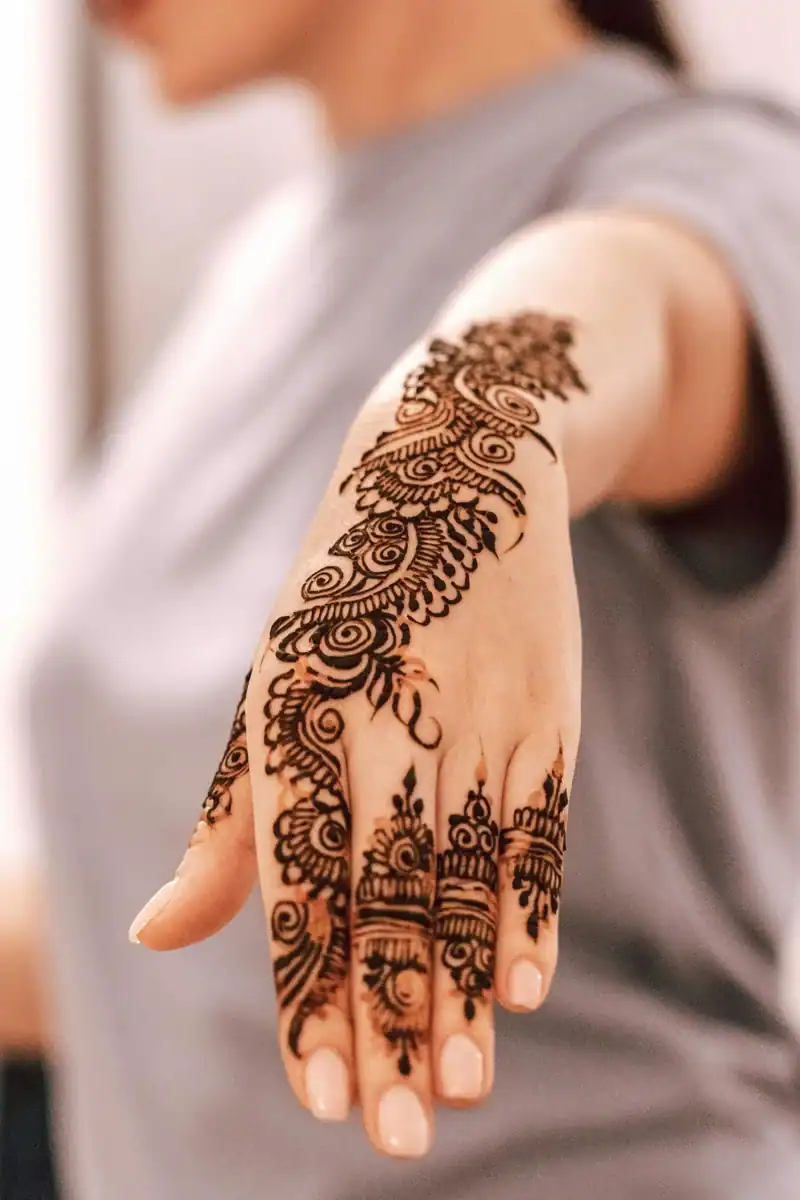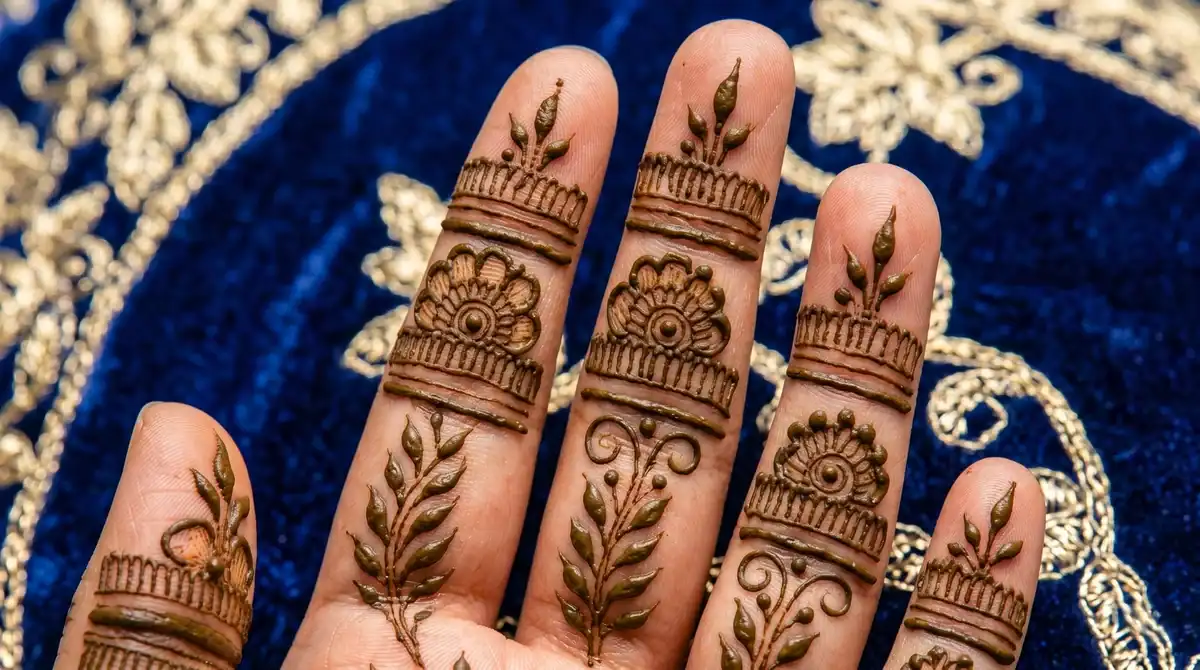
Bold Floral Crown Finger Mehndi Design With Stacked Ring Bands
30 min · Beginner

Browse — Stylish
The contemporary middle — more decorative than simple, lighter than royal, twenty to forty minutes per hand. 3 curated stylish mehndi design ideas across every tradition and placement.
About this collection
"Stylish" gets used loosely in mehndi vocabulary — sometimes for anything that looks polished, sometimes for anything that is currently trending. We use it precisely. A stylish mehndi design sits in the contemporary middle of the spectrum: more decorative than simple (which leaves more skin bare than covered), lighter than royal (which is bridal-weight by definition). Application time twenty to forty minutes. Coverage fifty to seventy per cent of the available surface. One or two motif families rather than three or more layered.
Stylish is the default mehndi format for occasions that are not the wedding itself. Sangeet, Eid, Karwa Chauth, engagement parties, baby showers — all of these reach for stylish patterns, not royal ones. The wearer wants something more than a single motif but less than a four-hour bridal sit; stylish is the answer to that brief. It is also the most-shared mehndi format on Instagram and Pinterest, because the motif clarity (one or two families with breathing room) photographs better than royal density (which dissolves into texture in thumbnails).
Three diagnostic markers
Three things have to be true at once. Any single marker on its own is simple-with-extras or royal-without-density.
A stylish design covers more than half the available surface but less than eighty per cent. The remaining bare skin is composed — gaps between the motifs, breathing room around the central element. Less than fifty per cent and you are looking at simple; more than eighty and you are in royal territory.
A stylish design uses one or two distinct motif families: a single rose with leaves, a mandala with surrounding vines, a peacock with a finger paisley walk. Royal designs layer three or more families together; simple designs use one motif with no extension. Two is the stylish sweet spot.
A stylish design takes twenty to forty minutes per hand because the coverage and motif extension cannot be applied faster, but does not need the full bridal sit. Anyone offering "stylish" mehndi in five minutes is selling simple; anyone offering it in ninety is selling royal-with-the-wrong-name.
Stylish is the contemporary middle of the spectrum — more decorative than simple, lighter than royal. A stylish design uses one or two recognisable motif families with breathing room between them, twenty to forty minutes of application time, and a composition designed to photograph well. Rose at the back of the hand with khafif filling, mandala at the palm with surrounding vines, peacock running along the index finger — these are all stylish, none of them are simple, and none reach royal density.
Twenty to forty minutes per hand. Slower than simple (five to fifteen minutes) because there is enough motif and connecting work to fill the hand without bare gaps. Faster than royal (sixty to a hundred and twenty minutes) because the motif vocabulary is one or two families rather than three or more layered, and the line weight is uniform rather than mixing bold and fine.
Coverage and motif count. A simple design is a single motif with surrounding bare skin — one mandala at the palm, one rose at the back of the hand, three buti scattered across the wrist. A stylish design extends that motif with connecting work: vines from the rose to the wrist, dot trails from the mandala to the fingers, a bracelet at each finger base. Same vocabulary, more of it.
Density, motif layering, and time. A royal design covers eighty per cent or more of the hand with three or more motif families layered together, takes sixty to a hundred and twenty minutes per side, and is bridal-weight by definition. A stylish design covers fifty to seventy per cent with one or two motif families, takes twenty to forty minutes, and is suited to sangeet, Eid, and Karwa Chauth rather than the wedding day itself.
Almost everything except the wedding day and casual Tuesdays. Sangeet (the bride wears stylish, not royal — she saves royal for two evenings before the wedding). Eid (Arabic-leaning stylish patterns dominate Gulf and South Asian Eid wear). Karwa Chauth (front-hand stylish with bracelet motifs is the canonical choice). Engagement parties, baby showers, sangeet for the wedding party rather than the bride. Stylish is the default mehndi format for occasion-wear that is not the main event.
Yes — stylish is the natural step up from simple once your line work is steady. The motif vocabulary is the same as simple (mandala, lotus, rose, paisley) but extended with connecting elements that need only basic technique: vines, dot trails, bracelet bands. Skip the more advanced stylish formats (peacock running the length of a finger, khafif filling around a Pakistani rose) until your second or third stylish hand. Start with a mandala extended with three trailing vines.