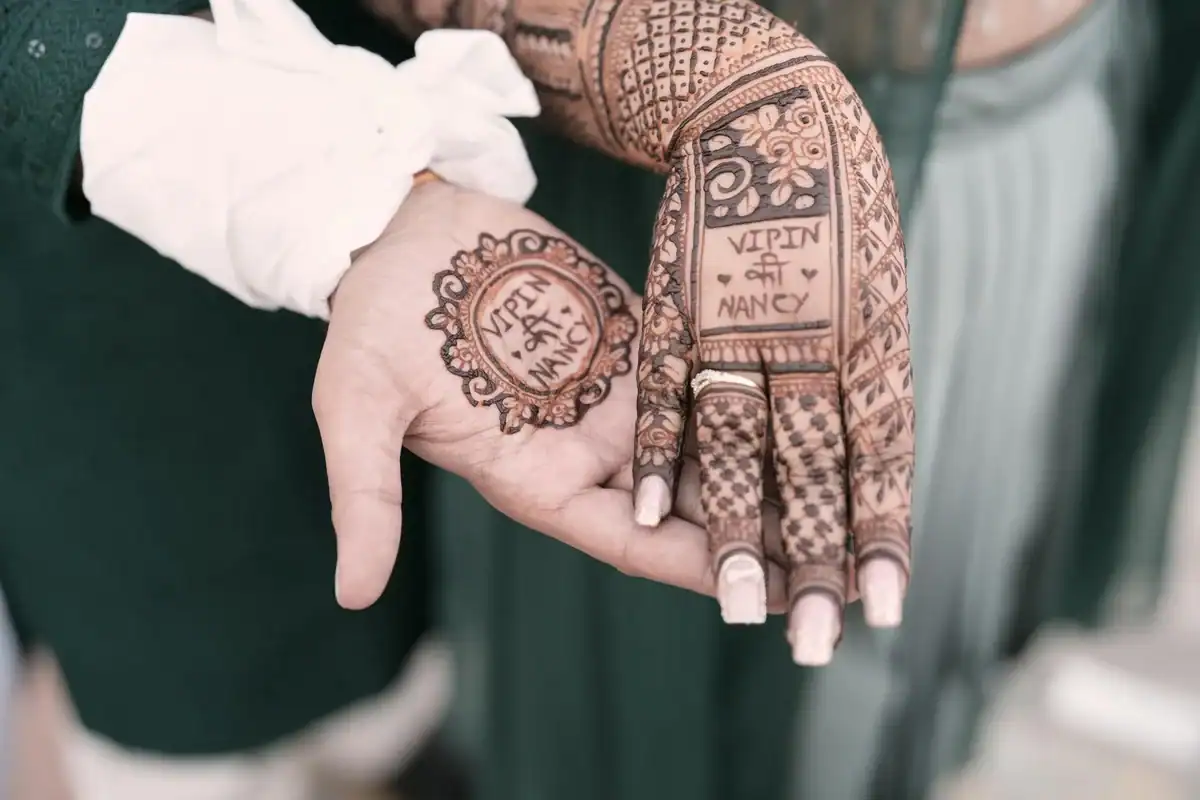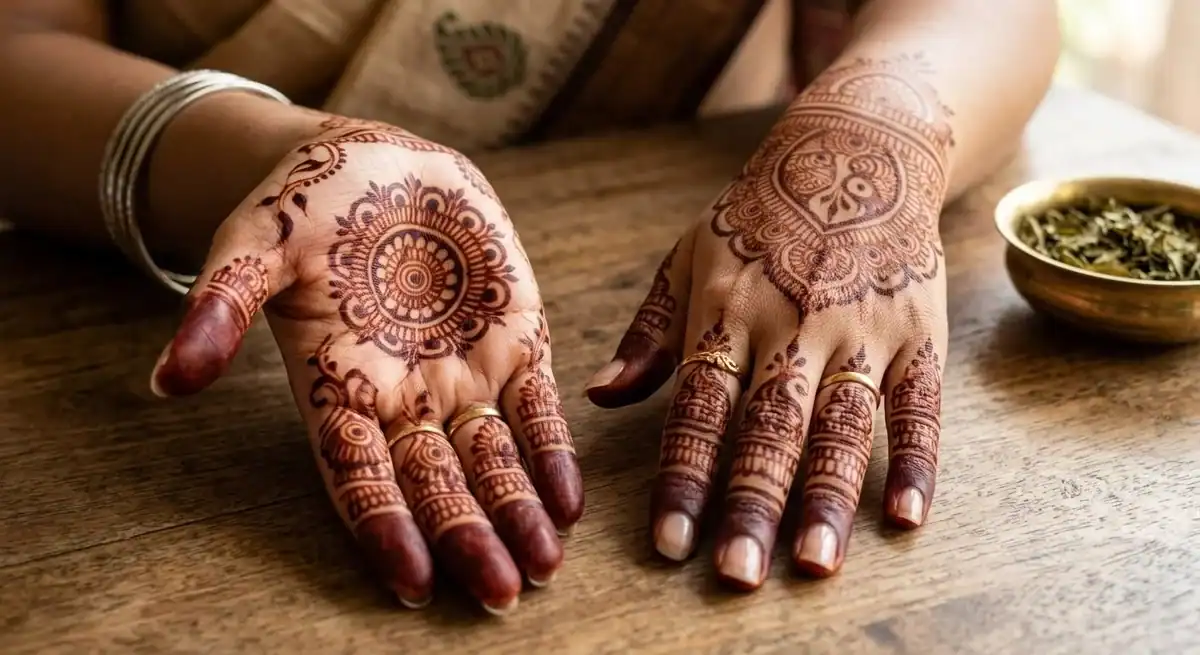
Royal Mandala Full Hand Bridal Mehndi with Geometric Jaal Fingers
90 min · Advanced


Browse — Full hand
Wrist anchor, palm or back, all five fingers, fingertip caps — composed as one continuous piece. 2 curated designs from our studio, including bridal-weight patterns from our resident artists.
About this collection
A full hand mehndi design — full hand mehandi, full hath mehndi, or dulhan mehndi when worn for a wedding — covers the entire hand in a single composed pattern: wrist anchor, palm or back, all five fingers, fingertip caps. The defining feature is continuity. A hand with a separate wrist mandala, a separate palm rose, and three separate finger motifs is not a full hand design; it’s several smaller designs sharing a canvas. Full hand work is composed as one piece, with the wrist anchor visually flowing into the palm filling, into the finger bracelets, into the fingertip caps.
That continuity is what makes the placement bridal by default. Sixty to ninety minutes of uninterrupted application; a planned composition rather than improvised motifs; the wrist, palm, back of hand, and fingertip all reading as one image. Lighter Arabic full-hand patterns dial the density down for sangeet and Eid without losing the continuity — the wedge motif still flows across the placement. Royal Indian and Pakistani patterns push density up for the wedding day itself.
Anatomy of a full hand
The shorthand artists use to plan a full hand before the cone touches skin.
A bracelet, mandala, or border pattern that wraps the wrist and acts as the visual base of the design. Everything else flows up and out from here. In Indian tradition the anchor is typically a wide ornamental bracelet; in Arabic it’s often a single bold rose with leaves; in Pakistani khafif it’s a band of fine filling.
The palm or back-of-hand surface — the largest area, where the dominant motif family lives. Indian designs fill this densely with paisleys, jaal nets, and small buti. Arabic leaves much of it bare and places one or two large motifs. Pakistani fills with khafif around a bold rose centre.
A band that wraps each finger at the second knuckle — sometimes a continuation of the wrist anchor’s motif, sometimes a smaller variation. Always present in bridal work, optional in lighter full-hand designs. Pakistani patterns often skip these; Indian rarely do.
The strip from second knuckle to fingertip — paisleys staggered down, vines, or scattered motifs. This is the slowest part of the application; the finger surface is curved and the cone has to be rotated continuously.
The top of each finger, fully filled in solid stain — a tradition that signals "bridal" more than any single motif does. Caps are skipped on lighter full-hand designs; brides almost always include them.
A full hand design covers the entire hand — wrist anchor, palm or back of hand, all five fingers, and the fingertips — in a single composed pattern. The defining feature is continuity: the design reads as one piece rather than three or four separate motifs at different locations.
Sixty to ninety minutes per side, depending on density. A modern Arabic full hand with bold motifs and generous negative space is sixty; a traditional Indian or Pakistani full bridal hand with layered jaal, paisleys, and finger work is ninety to a hundred and twenty. Bridal mehndi for both hands is typically a four-to-five-hour sit.
No, but it leans bridal by tradition. The earliest full-hand patterns emerged for South Asian weddings, and the deepest, longest applications are still associated with the bride and her closest family. Lighter Arabic and stylish full-hand designs are increasingly worn for sangeet, engagement, and Eid — the framing is the same, the density is dialled down.
Traditionally yes — bridal mehndi is composed as a unified piece, with the front-hand and palm-side patterns echoing each other’s motifs and balancing the wrist anchor. Modern Arabic-influenced bridal mehndi sometimes leaves the palm bare or applies a different motif family, but the symmetric approach is still the default across India and Pakistan.
Two days before is the sweet spot. Apply on the mehndi night (typically two evenings before the wedding), set overnight, scrape the next morning, then steam with cloves through that day. The colour deepens for forty-eight hours, peaking the morning of the wedding itself. Apply same-day and you’ll wear an orange stain to the ceremony.
Not honestly — full hand work is the most advanced placement category we publish. The challenge isn’t any single motif; it’s composing the whole hand as one continuous piece while maintaining a steady line for ninety minutes straight. If you want to try, start with a modern Arabic full hand at a low density: a single bold vine from wrist to fingertip with one rose at the back of the hand and three leaves trailing down two fingers. Skip the palm side for your first attempt.